Chiprun · siliconless firmware simulation
Give your coding agent real hardware. Virtually.
An agent can write firmware. It can't run it on a chip, see what the chip did, or fix what it can't observe. Chiprun closes that loop over a single MCP endpoint — no board on a desk, no flashing, no waiting.
Free tier, no credit card. 11 boards across 3 chips, and the board is simulated too — not just the CPU.
# your agent, connected to https://urdb.io/mcpchiprun_list_boards()→ uno · atmega328p · avr-nonechiprun_create_firmware_upload()→ upload_url, firmware_id (PUT your ELF)chiprun_run_firmware({ board: "uno" })→ Hello world!
The loop, closed at the hardware.
01
Connect the endpoint
Point your coding agent at https://urdb.io/mcp with an API key. Standard MCP — Claude Code, Cursor, and anything else that speaks the protocol.
02
Upload a compiled ELF
Cross-compile on your side and PUT the binary to a presigned upload slot. We run it as-is; nothing about your toolchain has to change.
03
Read the UART back
The run returns inline with whatever the chip printed. Bounded by virtual CPU time, so a runaway loop returns at the cap instead of hanging.
What we're building
Two products, one endpoint, one API key.
Firmware simulation, over MCP
Your agent uploads a compiled ELF, runs it on a virtual instance of a real microcontroller, and reads the UART output back. No board on a desk, no flashing, no waiting.
Runs are bounded by virtual CPU time, so firmware that loops forever returns at the cap with whatever it printed — it never hangs your agent.
Read the quickstartArduino Uno R3
uno · avr-none
Arduino Nano (ATmega328P)
nano · avr-none
Arduino Pro Mini 5V/16MHz
pro-mini-16 · avr-none
Arduino Pro Mini 3.3V/8MHz
pro-mini-8 · avr-none
Arduino Duemilanove (ATmega328)
duemilanove · avr-none
Arduino Mini
mini · avr-none
LilyPad Arduino
lilypad · avr-none
Arduino Mega 2560
mega2560 · avr-none
Arduino Mega ADK
mega-adk · avr-none
Arduino Diecimila (ATmega168)
diecimila · avr-none
Arduino Nano (ATmega168)
nano-168 · avr-none
More boards and architectures are landing continuously — each ships only with a passing smoke test on its own chip.
Latest from URDB
View all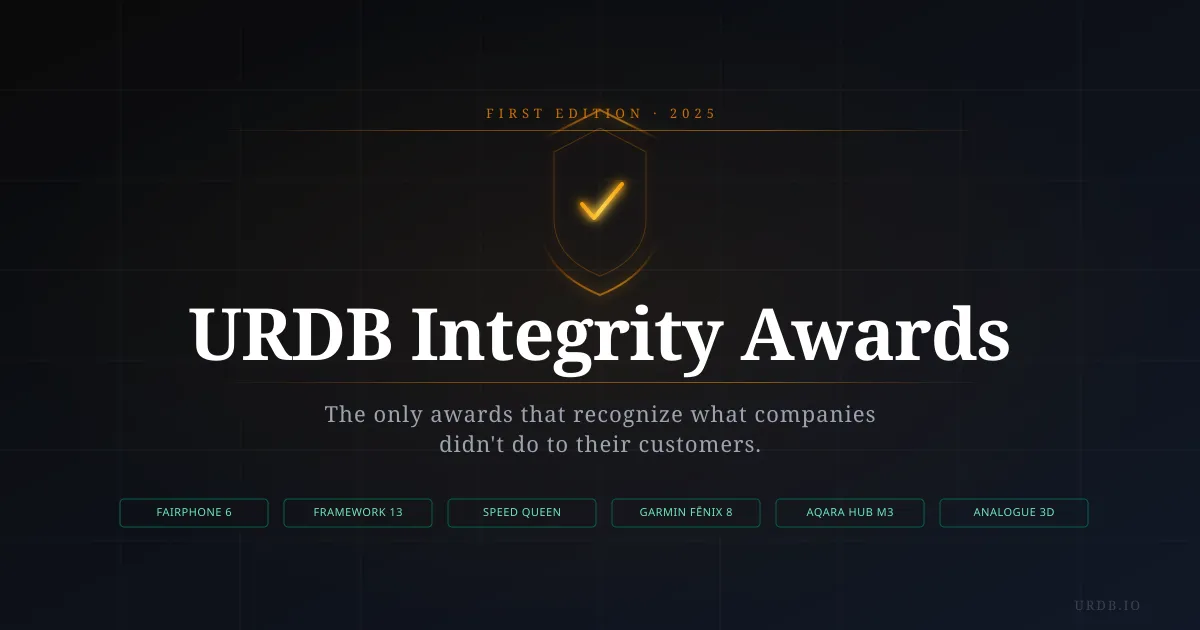
And the database that started it.
URDB tracks how consumer products get worse over time — downgrades, warranty cuts, feature removals — scored and evidence-backed. Query it from the same MCP endpoint.
Top rated
Nikon - D850 DSLR 4k Video Camera (Body Only) - Black
Nikon
Apple - iPad mini (A17 Pro chip) - Built for Apple Intelligence - Wi-Fi 128GB - Blue
Apple
Apple - 13-inch iPad Pro M4 chip Built for Apple Intelligence Wi-Fi 256GB with OLED - Silver
Apple
Apple - MacBook Air 15-inch Laptop - Apple M4 chip Built for Apple Intelligence - 16GB Memory - 256GB SSD - Sky Blue
Apple
Apple - MacBook Pro 13.3" Laptop - M2 chip - 8GB Memory - 256GB SSD - Space Gray
Apple
The bridge between AI agents and the hardware they run on.
Create a key, point your agent at the endpoint, and run your first firmware in about a minute.
Start free