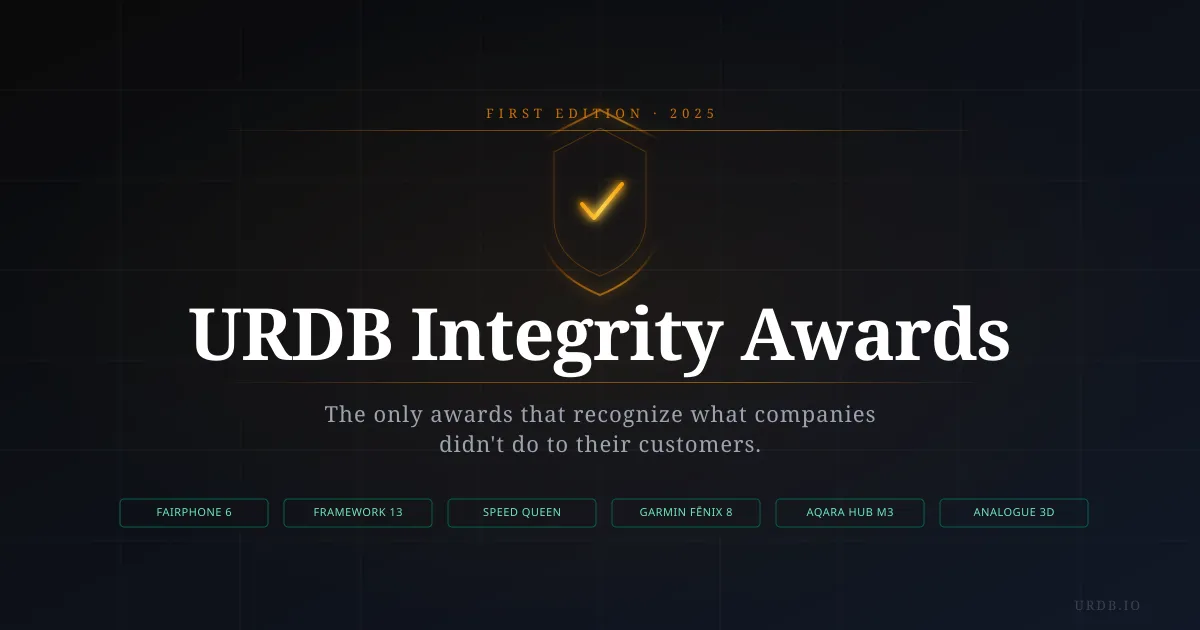
The URDB Integrity Awards 2025: The Full Story
When we started building URDB, we weren't thinking about awards. We were thinking about washing machines.
Specifically, about the moment — familiar to anyone who has bought an appliance in the last decade — when you unbox something expensive and realize that the features listed on the box are contingent. That the "smart" in smart appliance means the manufacturer retains a permanent connection to your home through which they can, at will, change what the product does. That the $2,500 you spent on a refrigerator bought you hardware, not control.
The database we built to track those changes — the versions, the firmware updates, the warranty revisions, the quiet material substitutions — accumulated over time into something larger than any individual product. It became a record of an industry-wide pattern: the systematic extraction of value from products after the point of sale, through mechanisms that most consumers never agreed to and often never notice.
The Integrity Awards exist because that record deserves to cut both ways. The companies that resist these patterns — that build products designed to last, that treat post-purchase software as a tool for improvement rather than extraction, that make and keep commitments about what their products will do and for how long — deserve to be named as clearly as the ones that don't.
This is the story of the first edition. Every winner. Every Hall of Shame inductee. And the choices, documented in sourced evidence, that put them there.
How the Awards Work
The URDB integrity score is built from seven dimensions: durability, repairability, material quality, version stability, anti-shrinkflation, firmware and lock-in behavior, and ownership integrity. Each dimension is weighted. The composite score is a number between 0 and 100.
What it is not is a review. We do not evaluate performance. We do not test audio quality or processing speed or camera output. Those dimensions are covered exhaustively by every tech publication in existence. What they almost never cover — the repairability of the chassis, the independence of features from cloud infrastructure, the history of what has been removed versus what has been added through software updates, the terms of the warranty and how those terms have changed — is what URDB measures.
For the 2025 awards, the judging panel reviewed products released or substantially updated during the calendar year. Winners were required to meet a minimum threshold of 60 points on the composite scale. Where no product in a category met that threshold, the award was withheld. We withheld two.
The Hall of Shame has no minimum threshold in the negative direction. It has a different standard: documented, sourced evidence of a specific enshittification pattern, significant enough in scope or cynicism to warrant naming publicly.
Three judges reviewed every decision: Aditya Thakur, founder of URDB; Grégoire Benveniste, Project Leader at ALTEN, whose career in industrial project management has given him a finely calibrated radar for the gap between what products promise and what they deliver; and Adam Remelman, Manufacturing Engineer at LAM Research, who builds systems that have to work correctly the first time because there is no firmware patch for a semiconductor fab. His standard for "built to last" is not rhetorical.
The Winners
Best Integrity: Smartphone — Fairphone 6
There are approximately 1.4 billion smartphones sold globally each year. Of those, the vast majority are designed on the assumption that they will be discarded within three years. The battery will degrade to the point where the user replaces the phone. The software support window will close, leaving the device technically functional but practically obsolete. The repair cost, if something breaks, will approach or exceed the cost of a new device. This is not an accident of technology. It is a business model.
The Fairphone 6 is a deliberate rejection of that model, and the rejection is thorough enough to be remarkable even after years of the company doing it. iFixit gave it a 10/10 repairability score — the highest possible, a designation that at time of writing applies to fewer than a dozen consumer electronics products in existence. Every component that commonly fails in a smartphone — the battery, the display, the USB-C port, the cameras — is user-replaceable with a standard screwdriver. Not a proprietary tool. Not a heated prying instrument. A screwdriver.
The warranty is five years. The OS update commitment is eight years. The materials sourcing program — fair-mined cobalt and gold, recycled plastics, conflict-free supply chains — is audited and published. The bootloader is unlockable, meaning that when Fairphone's software support eventually ends, the community can continue providing updates independently. Alternative operating systems are officially supported.
The Fairphone 6 is not the most powerful smartphone released in 2025. It is not the best camera. It will not run the most demanding applications at the highest settings. It is, however, the smartphone most likely to still be functional in 2033 — and the one whose manufacturer has made the most enforceable commitments about what will happen between now and then.
That is what we are measuring. The Fairphone 6 is the best smartphone of 2025 by those measures, and it isn't close.
Best Integrity: Laptop — Framework Laptop 13 (2025)
The Framework Laptop asks a question that most laptop manufacturers would prefer you not think about: if you bought this computer in 2022, why should it be obsolete in 2025?
The answer, in most cases, is that it shouldn't. The chassis is fine. The keyboard is fine. The trackpad is fine. What changes between generations is the mainboard — the processor and memory and associated silicon — and the port configuration. Framework builds its laptop around the premise that those are the only things that should need to change, and that everything else should be designed to accommodate that change rather than requiring replacement.
The result is a laptop where a 2022 chassis accepts 2025 mainboards. Where the battery, keyboard, display, speakers, and trackpad are individually replaceable by a user with a screwdriver and the manual available on Framework's website. Where the expansion card system — the modular port configuration that lets you choose which ports you want and change them later — means that the decision you made in 2022 about USB-C versus HDMI is not permanent.
iFixit gave it a 10/10. The only other laptops that have received that score in recent memory are earlier Framework models. The company is building a product line, not a planned obsolescence cycle.
The Framework Laptop 13 (2025) won Best Integrity: Laptop because it scores near the ceiling on every dimension we measure, and because the company's track record — firmware support, parts availability, the backward compatibility commitment — substantiates the current scores with historical evidence. They have done what they said they would do.
Best Integrity: Headphones — Fairphone Fairbuds XL (2025)
Earlier in this issue we wrote about the systematic degradation of premium headphone internals — how the hinges got thinner, how adhesive replaced fasteners, how the repairability scores of flagship Sony and Bose and Jabra products declined year over year while the prices held steady or increased. The Fairbuds XL are the specific product that proves the degradation is a choice, not an inevitability.
The Fairbuds XL have a user-replaceable battery. User-replaceable cushions. User-replaceable speaker covers. A user-replaceable headband. User-replaceable drivers. No special tools required for any of it. The warranty is three years. Spare parts availability is committed to indefinitely — not the five-year minimum that EU law requires, but ongoing, as long as the product exists.
There is no subscription. No DRM. No app required for core functionality. You can use them with a cable.
This is not a stripped-down product. The Fairbuds XL have active noise cancellation, a companion app for those who want it, and competitive audio specifications. The modular design did not require sacrificing the features that premium headphone buyers expect. It required designing for longevity from the beginning, rather than treating longevity as a cost to be optimized away.
The headphone category, as we documented, has moved broadly in the wrong direction. The Fairbuds XL moved in the other direction. They won.
Best Integrity: Appliance — Speed Queen TR7
We gave Speed Queen the Lifetime Integrity Award separately, which we'll discuss. The TR7 earned the category award on its own terms.
The Speed Queen TR7 is a top-loading washing machine designed around a mechanical agitator — the older, simpler technology that has been largely phased out of consumer appliances in favor of high-efficiency impeller designs that are more gentle on clothes and more efficient on water but also, in practice, more complex and more likely to fail. Speed Queen kept the agitator because it works and because it lasts. The TR7 is rated for a 25-year residential lifespan. Speed Queen's commercial washers — built to the same engineering standards as the residential machines, used in coin laundries where a machine might run eight hours a day for decades — are the proof of concept.
The TR7 has no Wi-Fi. No app. No subscription. No firmware update has ever changed what it does. The warranty is seven years on parts and labor — the longest in the residential appliance category by a substantial margin. Parts are stocked through commercial supply chains and available at independent appliance parts retailers nationwide.
When we described the Lifetime Integrity Award, we said Speed Queen is the platonic ideal of a product that does exactly what it says, forever. The TR7 is the specific instantiation of that ideal.
Best Integrity: Wearable — Garmin Fēnix 8
The smartwatch market has bifurcated into two models. In one model, the watch is a hardware platform for a subscription ecosystem: features locked behind monthly fees, data held in proprietary clouds, maps that require ongoing payment, analytics that degrade without a premium tier. In the other model, the watch is a device that does what it does when you buy it, without ongoing payment, without cloud dependency, without a subscription that turns a $500 purchase into a $500/first-year + $X/subsequent-year commitment.
The Garmin Fēnix 8 is the latter model at the highest tier of the category. All core features are available without a subscription: GPS tracking, heart rate monitoring, sleep analysis, training load metrics, recovery time recommendations, pulse oximetry, stress tracking. Offline topographic maps for the entire world are included at purchase, stored on the device, functional without a data connection in locations where there is no data connection to have.
Data exports to standard formats. The watch works with both Android and iOS without a walled-garden dependency on either. The third-party app ecosystem (Connect IQ) is genuinely open.
Garmin's approach to the subscription question is, in context, almost radical: they decided not to build a subscription business on top of their hardware business, and the product reflects that decision at every level. The Fēnix 8 won because Garmin made the right choice and made it thoroughly.
Best Integrity: Smart Home — Aqara Hub M3
The smart home market's original sin is cloud dependency. A smart home device that requires the manufacturer's servers to function is not a smart home device — it is a rented service delivered through hardware you paid for. When the manufacturer's servers go down, your automation doesn't run. When the manufacturer discontinues the product, your automation stops running permanently. When the manufacturer is acquired or goes bankrupt — and this is not a hypothetical, as we document in the Hall of Shame — your hardware becomes a paperweight.
The Aqara Hub M3 is built around the opposite premise. It is Matter and Thread certified, meaning it speaks the open protocols that allow interoperability across ecosystems. All automations run locally: they do not require an internet connection, they do not ping a server in China or California, they execute on hardware in your home even if every datacenter in the world is offline. There is no subscription. There is no microphone. There is no camera.
It works with Home Assistant, HomeKit, Google Home, Amazon Alexa, and SmartThings — simultaneously, through standard protocols, without requiring you to choose. In a category defined by walled gardens and proprietary lock-in, the Aqara Hub M3 is the opposite of that. It won because it exists in a category that desperately needed a winner.
Best Ownership: Wearable — Amazfit Active 2
The Amazfit Active 2 costs $99. For $99, you receive: GPS tracking, heart rate monitoring, sleep analysis, blood oxygen monitoring, body temperature monitoring, and stress tracking. All features are available at purchase. None require a subscription, ever. The battery lasts ten days.
This award is not about the Amazfit Active 2 specifically. It is about the comparison it forces. At $399, the Apple Watch Ultra requires an Apple One subscription to access the majority of its health analytics in any meaningful depth. At $329, the Fitbit Sense 2 has features that require a $10/month Fitbit Premium subscription to unlock. At $249, the Samsung Galaxy Watch 6 Classic degrades without a Samsung Health Monitor subscription.
The Amazfit Active 2 offers more unlocked health functionality at $99 than most premium smartwatches offer without a subscription tier. This award names that disparity for what it is: a pricing strategy that has nothing to do with hardware costs and everything to do with converting hardware buyers into subscription revenue. The Amazfit Active 2 is the proof that the subscription model is a choice, not a necessity.
Awards Withheld: Television and Gaming Console
No television released in 2025 met the 60-point minimum threshold on the ownership and firmware dimensions. This is not because televisions got worse in 2025 — they didn't, meaningfully. It is because the baseline for smart TV ownership has declined to the point where a minimum 60-point score would require a product that simply does not exist at any price point from any mainstream manufacturer.
Every major smart TV platform monetizes its users through advertising displayed on the home screen, behavioral data sold to third parties, ACR (Automatic Content Recognition) technology that surveys what you watch and reports it to the manufacturer and their data partners, and interface designs that prioritize the manufacturer's streaming partnerships over straightforward access to your content. These are not bugs. They are the business model. The hardware margins on televisions are thin; the data and advertising revenue is where the money is.
We will not award a product for "least bad" when "least bad" still clears a bar that is objectively low. The television award was withheld. It will be withheld again in 2026 unless something changes.
The gaming console category was withheld for related reasons. The Nintendo Switch 2 was the strongest candidate — it scored highest among 2025 console releases — and then Nintendo issued a Terms of Service update in May 2025 allowing consoles to be permanently disabled for Terms of Service violations. That provision, combined with the firmware regression documented in the Hall of Shame, made the Switch 2 ineligible for a positive award and instead a Hall of Shame inductee. No other 2025 console release performed better on the ownership dimensions. The award was withheld.
Special Awards
Product of the Year — Fairphone 6
The Product of the Year distinction goes to the product that scores highest across all URDB dimensions simultaneously — not the highest in any single category, but the highest aggregate, the product that comes closest to the ideal of a consumer product designed with the buyer's long-term interests as the primary constraint rather than a secondary consideration.
Fairphone 6 is the only mainstream 2025 consumer device that scores high on all seven dimensions at once. Repairability: 10/10 iFixit score. Material quality: fair-mined and recycled materials, audited supply chain. Ownership integrity: unlockable bootloader, alternative OS support, no carrier lock-in. Version stability: eight-year update commitment. Anti-shrinkflation: same price tier with more capability than the prior generation. Firmware behavior: no documented feature removal in the product history. Durability: 5-year warranty, MIL-STD-810 rated.
No other product on our 2025 list does all of those things simultaneously. Most do one or two. Fairphone 6 does all of them, which is why it is both the Best Smartphone and the Product of the Year.
It is worth noting what this means about the broader market. The best consumer electronics product of 2025 — by the measures that reflect whether a product actually serves the person who buys it over the long term — is made by a company with annual revenue of roughly €300 million selling into a market dominated by companies with annual revenues of hundreds of billions. The scale of the winner reflects how marginal these values are in the mainstream market. Fairphone exists in a niche because the mainstream has decided these values are a niche.
Most Improved Brand — Apple
This is the award that generated the most internal discussion. Apple is not a company that wins awards for consumer-friendliness. Apple is the company that invented parts pairing to prevent independent repair. Apple is the company that lobbied against Right-to-Repair legislation for years. Apple is the company that solders RAM to mainboards and glues batteries into phones and fights in court to maintain its grip on every aspect of its hardware ecosystem.
All of that is true. The arc of 2022–2025 is also true, and it moves in a different direction.
The PIRG "Failing the Fix" annual scorecard tracks manufacturer behavior on repairability across the industry. In 2022, Apple received an F. In 2025, Apple received a B-. No other manufacturer improved as substantially over that period. Self Service Repair, Apple's DIY repair program, now covers more than 40 products in 33 countries. The iPhone 16 series earned the highest repairability score ever for an iPhone — 7/10 from iFixit, up from scores in the 3-4 range for most iPhone generations since the iPhone 4. The M5 iPad Pro earned the highest repairability score ever for any iPad.
We are not awarding Apple for being good. We are awarding them for moving in the right direction after moving in the wrong direction for long enough that the movement is documented, measurable, and meaningful. The award is "Most Improved" — not "Best." The arc of improvement is real. It is also not complete. The parts pairing system is still in place. The EULA provisions that restrict what you can do with Apple hardware are still in place. The App Store monopoly is still in place.
What changed is that when Right-to-Repair legislation became politically unstoppable, Apple chose to get ahead of it rather than continue fighting it. Whether that choice was made from conviction or from calculation is less important than the fact that it produced outcomes — the Self Service Repair program, the improved repairability scores, the genuine expansion of independent repair access — that are better for consumers than what existed before.
Awarding progress incentivizes more of it. We named it.
Best Comeback — Sonos
The Sonos story of 2024–2025 is, in its way, a story about what accountability looks like in consumer technology — which is to say, what it looks like when it happens, because it rarely does.
In May 2024, Sonos launched a redesigned mobile app. The redesign removed features that had existed in the previous app for years: local music library search, playlist editing, sleep timers, and queue management. These were not obscure features. They were things people used. The replacement app had been in development for two years and shipped missing functionality that its predecessor had since 2015.
The backlash was extraordinary in its scale and duration. Not the usual two-week news cycle. A sustained, organized campaign by Sonos's most loyal customers that damaged the brand measurably and permanently. The company's stock fell. Its Net Promoter Score collapsed. CEO Patrick Spence, who had approved the launch, was forced out in January 2025 after months of pressure that began from the day the app shipped.
His replacement, Tom Conrad, had spent years at Pandora and understood that a music product lives or dies on the trust of its users. He committed publicly to restoring the missing functionality. He published a roadmap. He reported progress against that roadmap regularly. By the end of 2025, the majority of the missing features had been restored, with a full app rebuild — not a patch on top of the broken foundation — committed to for 2026.
This is the Best Comeback because Sonos did something that consumer technology companies almost never do: they accepted that they had degraded their product, they accepted the consequences of doing so, and they spent a year earning back what they had lost. The degradation was real and egregious. The recovery was also real. Both deserve acknowledgment.
We note, without comment, that the mechanism for recovery was: customers punished the company financially and organizationally until the company changed course. The lesson for other companies is clear. The lesson for consumers — about why organizing, complaining loudly, and voting with wallets matters — is equally clear.
Lifetime Integrity Award — Speed Queen
Speed Queen has been manufacturing washing machines in Ripon, Wisconsin since 1908. In 117 years, the company has made washers for commercial coin laundries and residential homes, and it has understood that the commercial and residential products are in the same business: making machines that run, reliably, for as long as anyone needs them to.
The mechanical agitator design that Speed Queen uses in its residential machines is not unchanged in its details since 1908. It has been refined. The materials have improved. The efficiency has been optimized within the constraints of the core engineering approach. But the core engineering approach — mechanical simplicity, commercial-grade components, repairability as a design constraint rather than an afterthought — has not changed in its essentials. Because it works.
There are Speed Queen washers in service today that were manufactured in the 1980s. There are Speed Queen commercial washers in coin laundries that have processed hundreds of thousands of loads. The company offers a 7-year parts and labor warranty on residential machines — the longest in the category by years, not months — because they are confident enough in their product to make that commitment. Parts are available through commercial supply chains at any independent appliance parts distributor. No specialized authorization required. No proprietary diagnostic tool required. A competent technician can fix a Speed Queen washer with publicly available documentation and standard parts.
Zero documented enshittification events. No Wi-Fi added "for customer convenience" with a Terms of Service that gives Speed Queen access to your home network. No app that requires an account. No firmware update that changed what the machine does. No subscription for the rinse cycle.
The Lifetime Integrity Award does not go to the best product of any year. It goes to the product — and through it, the company — that has sustained the values that URDB measures over the longest period, at the highest consistency. Speed Queen has done that for over a century. The TR7 is what that looks like as a current product.
Indie & Kickstarter Awards
Best Small Company Integrity — Analogue 3D
The Analogue 3D is an FPGA-based recreation of the Nintendo 64 that plays original N64 cartridges in 4K. It comes from a small team in Seattle that has been making FPGA-based game hardware since 2011, that has never taken venture capital, that does not run a subscription service, and that ships products when they are ready rather than when a financial calendar demands it.
The product case for the Analogue 3D is simple: you own your cartridges. Those cartridges are the content. The Analogue 3D is a device that plays them, with no digital rights management, no online account, no cloud dependency, no terms of service that can change what the hardware does. The FPGA recreation means the games run as they ran on original hardware — not emulated, not approximated, but reproduced at the circuit level. In 4K.
All pre-orders were fulfilled before December 1, 2025. This is notable because Analogue pre-orders have historically taken longer than anticipated — the company ships when the product is ready — but the Analogue 3D shipped on time, at scale, without the common Kickstarter/pre-order failure modes of scope reduction, feature removal, or indefinite delay.
The gaming hardware market is dominated by platforms designed around ongoing revenue extraction: online subscriptions, digital storefronts with DRM-laden purchases, hardware that can be remotely disabled. The Analogue 3D is designed around the opposite premise. You own the hardware. You own the cartridges. No one can take that from you.
Best Kickstarter Integrity — Mudita Kompakt
The Mudita Kompakt is an e-ink Android phone. It exists because a small Polish company decided that the smartphone category had a problem — not a performance problem, but a philosophy problem — and built a product around a different philosophy.
The philosophy: a phone should reduce distraction, not maximize it. The e-ink screen makes video and infinite-scroll feeds practically unusable, which is the point. There is no Google Play Store by default — no advertising platform, no behavioral tracking, no data pipeline to a third party. You install only what you want to install, with explicit intent. The software environment is under your control, not optimized for engagement metrics on your behalf without your awareness.
The Kompakt funded on Kickstarter. It shipped exactly as promised: internationally in April 2025, North America in May 2025. These are the dates that were communicated to backers. The company hit them. This is Mudita's second Kickstarter hardware campaign — the first being the original Pure — and both campaigns have fulfilled completely without the delays, scope reductions, or feature removals that define most hardware crowdfunding at this scale.
The Best Kickstarter Integrity award does not go to the most ambitious product. It goes to the product that most fully honored the implicit contract of crowdfunding: we will make the thing we said we would make, by the time we said we would make it, and deliver it to the people who trusted us with their money in advance. The Mudita Kompakt honored that contract.
Hall of Shame
Post-Purchase Extraction — Samsung Family Hub Refrigerator
The Samsung Family Hub refrigerator costs between $1,900 and $3,000. That price buys you a refrigerator with a large touchscreen display — the "Family Hub" — built into the front door. The screen shows a calendar, a weather widget, a camera view of the refrigerator's interior, and other connected features. When Samsung's engineers designed this product, they built a display into an appliance you will own for 15-20 years. When Samsung's business development team looked at that display, they saw an advertising surface.
In September 2025, Samsung began piloting ads on Family Hub Cover Screens with no opt-out. The advertising pilot was announced, which is more than some companies do, but the announcement made clear that opting out was not possible — the only way to avoid the ads was to disconnect from Wi-Fi, which disables all smart features customers paid for.
The full OTA rollout came on October 27. Under public pressure, Samsung introduced a settings opt-out with the full rollout — but the opt-out came with a penalty. Disabling ads also disabled the weather widget, the news feed, and the calendar display. You could have ads or you could have the features. You could not have the features without the ads.
Samsung's PR team contacted URDB in March 2026 to dispute our characterization of the opt-out situation. Their statement described the opt-out process and noted that individual ads could be dismissed from the Cover Screen. We updated our records with the correction and published Samsung's statement alongside our original entry. We stand by the induction.
The timeline is: September pilot with no opt-out. October full rollout with a coercive opt-out that penalizes ad refusal. November partial fix that begins to decouple ad settings from widget settings. March 2026: Samsung contacts URDB to dispute the record.
At no point in this timeline were ads opt-in. At no point did Samsung ask the customers who paid $2,000 for a refrigerator whether they wanted advertising on it. The opt-out — which arrived three months after the pilot and only after sustained public backlash — is not a defense. It is evidence: evidence that Samsung monitored the response, calculated that the backlash had reached a threshold requiring response, and made the minimum adjustment required to reduce the backlash without abandoning the underlying strategy.
Post-purchase extraction means: selling a product, then changing the deal after the money has been paid. This is textbook post-purchase extraction, and it belongs in the Hall of Shame.
Firmware Lockdown — Nintendo Switch 2
Nintendo's November 2025 system update — firmware 21.0.0 — altered how the Switch 2 negotiates audio/video output over HDMI. The change broke third-party docks that had worked before the update: docks that customers had purchased specifically for use with the Switch 2, that had been compatible at time of purchase, and that became non-functional through a mandatory system update with no opt-out.
Nintendo did not announce this change. The update was described in release notes as a "stability improvement." The stability of the system's relationship with third-party hardware was not mentioned.
The affected customers had no recourse through Nintendo. Nintendo's support position was that the Switch 2 is designed for use with Nintendo-licensed accessories, and that third-party accessories are not guaranteed compatible. This is technically accurate. It is also, in context, a statement that Nintendo reserves the right to break compatibility with hardware its customers own through firmware updates issued without notice.
We gave this award to the Switch 2 rather than Nintendo generally because the Switch 2 is the specific 2025 product where this happened. Nintendo's pattern of behavior on third-party accessories is not new — they have a history of firmware updates that restrict third-party controller compatibility, that add authentication requirements to accessories, that define the approved ecosystem in ways that expand Nintendo's licensing revenue at the expense of customer choice. The Switch 2 inherited that pattern, and the November update expressed it clearly.
Whether the dock incompatibility was intentional anti-competitive behavior or reckless engineering, the outcome is the same: customers who bought third-party docks in good faith, using them with a console on which they functioned, lost that functionality because of a mandatory update they could not refuse. That is the Firmware Lockdown pattern. The Switch 2 is the 2025 case.
Cloud Coffin — Neato Robotics (and a Warning About iRobot)
This award names a pattern, not a single product, because the pattern is the story.
In October 2025, Neato Robotics shut down. The company's servers went offline. All cloud-dependent Neato robot vacuums became permanently non-functional. Not because the hardware failed. Not because the motors wore out or the sensors degraded or the navigation algorithms stopped working. Because a server went offline, and those vacuums required that server to run their core features.
Customers who paid $300-$500 for these devices — some within the past 18 months — found that their vacuums would not run a cleaning cycle, would not respond to the app, would not execute schedules, and would not return to their docks on command. The hardware was physically intact. The product was dead.
In December 2025, iRobot filed for Chapter 11 bankruptcy protection. iRobot is the largest robot vacuum manufacturer in the US market. The Roomba product line, like every modern Roomba, relies on iRobot's cloud infrastructure for its full feature set. iRobot's bankruptcy placed that infrastructure in identical jeopardy: a court-supervised restructuring that could, at any moment, determine that maintaining cloud servers for legacy Roomba units is not a viable expense for a bankrupt company.
The Cloud Coffin award does not require malicious intent. Neato Robotics probably did not plan to go bankrupt and brick its customers' vacuums. iRobot probably did not plan to file Chapter 11. The pattern is not about intent. It is about architecture: the decision, made by product teams at these companies, to build devices that cannot function without the manufacturer's ongoing cooperation. That decision transfers an enormous risk to the customer — the risk that the company's financial health will determine whether a physical product in their home continues to function — without disclosing that risk clearly at the point of sale.
When you buy a robot vacuum with cloud-dependent features, you are not buying a robot vacuum. You are renting a service delivered through hardware you paid for. The Cloud Coffin is what happens when the service ends.
The Hall of Shame runner-up was Microsoft, for ending Windows 10 support on October 14, 2025 — affecting an estimated 35-40% of all PCs worldwide — while simultaneously ending Office 2019 support, converting two separate paid-once products into dead-ends in the same month without a free upgrade path for hardware that met Windows 10 requirements but not Windows 11 requirements. The pattern is different from the Cloud Coffin — Microsoft's software continues to run, just without security updates — but the effect is the same: customers who paid for a product discovered that its effective lifespan had been determined by a third-party decision they had no part in making.
What We Learned
The first URDB Integrity Awards are, in an important sense, a message to the industry about what we are measuring and why.
The companies that won did not win because they made the most impressive products by conventional metrics. They won because they made choices — about repairability, about software behavior, about what post-purchase ownership means — that prioritize the buyer over the seller in the long run. Some of those choices are expensive. Framework builds backward compatibility into its laptop architecture at genuine engineering cost. Fairphone sources materials from audited fair-trade suppliers at genuine cost premium. Speed Queen maintains commercial-grade components in residential machines at a price that puts them above the mass market.
The companies in the Hall of Shame did not end up there because they are uniquely evil. Samsung is not the only company that has pushed advertising to smart appliance displays. Nintendo is not the only console manufacturer that has used firmware to restrict third-party accessory compatibility. Neato is not the only company that built a product dependent on cloud infrastructure that couldn't survive the company's demise. They are the cases where the pattern was clearest, the evidence was strongest, and the 2025 calendar year provided the most concrete documentation.
The broader message is structural. The ownership model for connected consumer products has been systematically shifting — through software licenses, cloud dependencies, firmware update policies, and parts restriction strategies — from "you bought it, you own it" to "you paid for access, on our terms, for as long as we decide." This shift benefits manufacturers at the expense of buyers. It is not disclosed clearly at the point of sale. And it is reversible: the winners in this issue prove that the alternative model is commercially viable.
We will run these awards every year. The Hall of Shame will have new inductees. The category awards will have new winners. Some of the Most Improved will become consistent achievers. Some of the current winners will make choices in the next twelve months that put them in the Hall of Shame.
The database keeps running. The record keeps accumulating. And we will keep naming what we find.
— The URDB Editorial Team, March 2026
Loading comments...