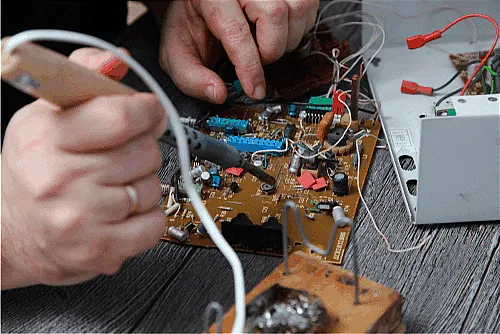
Why Your Appliance Repairman Is Going Extinct
In 1965, if your washing machine broke, you called a repairman. He showed up with a toolbox, diagnosed the problem, ordered a part from a local supplier, and fixed it. The whole transaction cost you $40 and two hours. The machine lasted another decade.
In 2025, if your washing machine breaks, you call the manufacturer's authorized service line. A technician comes out — in two weeks, if you're lucky — runs a proprietary diagnostic tool, orders a part that only ships from the manufacturer's warehouse, and charges you $350 for a repair that takes 45 minutes. The machine lasts three more years before the control board dies and replacement parts are discontinued.
The independent repairman who would have fixed it cheaper and faster doesn't exist anymore. Not because he retired without a successor. Because the industry systematically made his job impossible.
The Numbers Are Stark
The US appliance repair industry employed approximately 55,000 technicians in 2000. By 2023, that number had fallen to under 35,000 — a 36% decline over a period when the number of appliances per household increased substantially. The Bureau of Labor Statistics projects continued decline through 2032.
The average appliance repair cost has increased 68% in inflation-adjusted terms since 2005. At the same time, repair completion rates — the percentage of repair calls that result in a successful fix — have fallen, because technicians increasingly encounter parts they cannot source, software they cannot access, and designs they cannot safely service without manufacturer-specific tools.
The result is a repair economy that serves manufacturers far better than consumers. Authorized service networks charge more, fix less, and create a financial case for replacement over repair that didn't exist a generation ago.
How Parts Lockouts Work
The most direct mechanism killing independent repair is parts availability. Manufacturers have progressively restricted access to spare parts through several overlapping strategies:
Authorized distributor exclusivity
Major appliance manufacturers — Whirlpool, GE (now Haier), Samsung, LG — increasingly route parts sales through authorized distributors who require repair shops to meet certification requirements, minimum purchase thresholds, or franchise agreements. A technician who fixes appliances independently, without affiliation with an authorized service network, may find that the parts he needs are simply unavailable to him at any price.
This isn't hypothetical. Samsung stopped selling certain Galaxy smartphone parts to independent repair shops entirely in several markets. John Deere's parts are available to authorized dealers but not to independent agricultural mechanics. Certain Whirlpool control boards are listed as available but have 12-week lead times through independent channels — and same-week availability through authorized service.
Model proliferation and SKU fragmentation
There are now more appliance models on the market than at any point in history, and they share fewer components than ever. Where a 1990s washing machine might use one of a dozen common motor designs shared across brands, a 2024 model uses a proprietary motor assembly specific to a single production run. When that model's production ends, the motor goes end-of-life. Parts availability measured in years, not decades.
This isn't an accident. Shorter parts availability windows mean more appliances that become uneconomical to repair more quickly. That's replacement revenue — and it's baked into product planning.
Software-locked components
Physical parts are increasingly insufficient without software authorization. A replacement control board for a modern refrigerator may require programming with a VIN-equivalent serial number before it will function. That programming requires either the manufacturer's proprietary tool (not available to independent shops) or a trip to an authorized service center — which defeats the purpose of buying the part independently.
This is the appliance equivalent of Apple's parts pairing: the hardware is available, but its functionality is held hostage to software authorization that only the manufacturer controls.
The Diagnostic Paywall
Modern appliances are computers that also wash dishes. The diagnostic systems built into these appliances — the error codes, the sensor readouts, the failure logs — are increasingly accessible only through manufacturer-proprietary software.
A Samsung refrigerator that throws an error code can display that code on its panel. Decoding what the code means, accessing the full diagnostic tree, and identifying which of a dozen possible sensor failures is responsible requires Samsung's Smart Home service app — which is available to authorized technicians only, requires login credentials tied to a service agreement, and is not available to independent shops or consumers.
The practical consequence: an independent technician faces a refrigerator throwing an error code he can partially read. He knows the general system — refrigeration, not defrost, not electronics. But narrowing it to the specific failed component requires guesswork or the purchase of a service manual that may not exist for the current model year. Authorized technicians plug in a tablet and get a specific component call-out in 30 seconds.
This information asymmetry is not a byproduct of technical complexity. It is manufactured complexity. The diagnostic capability exists. The data is generated by sensors already in the machine. The manufacturer chooses to restrict access to it.
Design as a Repair Barrier
Independent of parts and software, modern appliances are frequently designed in ways that make repair more difficult — not as an engineering necessity but as a cost-optimization choice that happens to have the side effect of making repair harder.
Adhesives over fasteners
Glue is cheaper than screws in mass production. It's also much harder to work with in repair. A display panel secured with Phillips screws can be removed in three minutes. The same panel secured with industrial adhesive requires heat guns, plastic prying tools, and the risk of cracking the panel or the housing — a risk that falls entirely on whoever is attempting the repair.
Apple's use of adhesive in iPhone assembly is the most documented example, but the practice is widespread in appliances. Control panels, door seals, and component housings that were once held with fasteners are now bonded — saving the manufacturer pennies per unit while adding significant complexity and failure risk to repairs.
Proprietary fasteners
Pentalobe screws. Tri-wing screws. Torx Plus with a pin in the center. These aren't engineering innovations — standard Phillips and Torx fasteners hold things together just as effectively. Proprietary fasteners require proprietary tools. If you don't have the tool, you can't open the device. If the tool isn't commercially available, independent repair is simply not possible without drilling out the fasteners and replacing them with standard hardware.
The FTC documented this practice in its 2021 "Nixing the Fix" report, finding that several major manufacturers used proprietary fasteners specifically in locations that would need to be accessed for common repairs — a pattern that can only be explained by intent to restrict repair rather than engineering necessity.
Integrated components
Where previous generations of appliances used modular component designs — motors, pumps, and control boards as discrete, replaceable units — modern appliances increasingly integrate multiple functions into single assemblies. When one function in the assembly fails, the entire assembly must be replaced. A dishwasher pump that fails in a 2008 machine costs $40 to replace. The same pump integrated into a 2024 "pump-motor assembly" costs $280 — and the assembly also contains a perfectly functional motor, a flow sensor, and a filter housing that are all being discarded because the pump failed.
Integration serves manufacturing efficiency. It serves the aftermarket parts business. It does not serve repairability.
The Training Pipeline Has Collapsed
Even if the parts and diagnostic barriers were resolved tomorrow, the repair industry faces a human capital problem that would take a decade to fix.
Appliance repair training programs have been declining for years. Vocational schools that offered appliance repair certification have eliminated or consolidated programs as enrollment dropped. Enrollment dropped because the economics of independent repair deteriorated — lower completion rates, higher parts costs, customers increasingly opting for replacement — making the career less viable. The economic deterioration was driven in part by the same manufacturer practices that make repair harder.
It's a self-reinforcing cycle: harder repairs → worse economics → fewer people entering the trade → fewer skilled technicians → longer wait times → more customers opting for replacement → manufacturers have less incentive to support repair → harder repairs.
The average age of an appliance repair technician in the US is 54. Retirement is eliminating experienced technicians faster than training is producing new ones. The institutional knowledge of how to repair a 1998 Maytag — the kind of machine that will outlast anything sold today if properly maintained — is leaving the workforce permanently.
The Environmental Cost Nobody Mentions
A refrigerator contains approximately 120 pounds of steel, 20 pounds of aluminum, several pounds of copper wiring, a compressor with synthetic lubricants, and insulation foam that releases HFCs if improperly disposed of. Manufacturing a new refrigerator generates roughly 1,000 kg of CO2 equivalent. Repairing the existing one generates, at most, a few kilograms — plus the emissions of a service van making a house call.
The US discards approximately 9 million large appliances per year. An estimated 40% of those discarded appliances are functional or could be repaired for less than the cost of replacement — but aren't, because the repair ecosystem has been systematically degraded to the point where repair is unavailable, unaffordable, or practically impossible.
This is an environmental externality that manufacturers have successfully avoided internalizing. The emissions from manufacturing the replacement appliance don't appear on their balance sheet. The repair ecosystem they've degraded doesn't appear on their balance sheet. The landfill or recycling cost is paid by municipalities and consumers. The profit from the sale of the replacement appliance is theirs.
What Right to Repair Legislation Actually Does
The right-to-repair bills passed in Colorado, Minnesota, New York, and California — and the EU's Ecodesign Regulation — address the most obvious barriers: manufacturers must make parts available, must provide diagnostic documentation, and cannot void warranties for independent repair. These are real improvements.
What they don't address is the speed and scope of the problem. Parts availability requirements apply to products sold going forward; the installed base of appliances already designed to be unrepairable isn't covered. Diagnostic documentation requirements don't specify the format, completeness, or pricing of that documentation — a manufacturer can comply by publishing a service manual so expensive or incomplete that it's practically useless. And enforcement is slow, underfunded, and frequently outpaced by manufacturer technical countermeasures.
The EU's approach is more aggressive: mandatory minimum parts availability periods (7-10 years depending on category), standardized diagnostic interfaces, and design requirements that specifically address repairability. Early results are promising — EU-sold appliances from manufacturers subject to the Ecodesign Regulation show measurably better repair rates than US-sold equivalents from the same manufacturers.
The lesson is that disclosure requirements are insufficient. What changes behavior is mandatory design standards and mandatory parts stocking — requirements with teeth, backed by meaningful penalties for non-compliance.
What You Can Do Right Now
While legislation catches up with the problem, consumers can apply direct pressure through purchasing decisions:
- Check repairability scores before you buy. iFixit publishes repairability scores for electronics. URDB tracks repair-relevant metrics — warranty terms, part availability, firmware lock-in — across a broad range of consumer products. A product with a high repairability score is a product whose manufacturer has made deliberate choices to support your ability to fix it.
- Buy from brands with stated parts commitments. Framework Laptop guarantees parts availability for five years after a product's end-of-sale. Speed Queen builds commercial-grade internal components into residential machines and stocks parts for 15+ years. These commitments exist because consumers asked for them and paid for them.
- Repair before you replace, even when it's inconvenient. Every repair transaction that succeeds is evidence of demand. Every replacement purchase that follows a failed repair attempt because parts were unavailable is invisible — the manufacturer never sees the repair that didn't happen.
- Document parts unavailability when you encounter it. Leave reviews that specify the model, the failure, and the parts situation. Add change events to URDB when a manufacturer discontinues parts or changes their repair policy. This data is what turns anecdotes into evidence.
The appliance repairman isn't gone yet. But the window to preserve a functional independent repair ecosystem — and with it, the ability to own products that you can actually fix — is narrowing. The forces working against repair are systematic and well-funded. The response needs to be equally systematic.
It starts with understanding what's being taken, and why.
Loading comments...